

Employment relationships are presumed to be “at-will” in all U.S. states except Montana. The U.S. is one of a handful of countries where employment is predominantly at-will.

Federal laws don’t protect an employee’s political beliefs in the workplace, but some states do. For example, California protects a person’s right to be politically active outside the workplace, and an employer can’t penalize them for those activities.

by pacetulsa
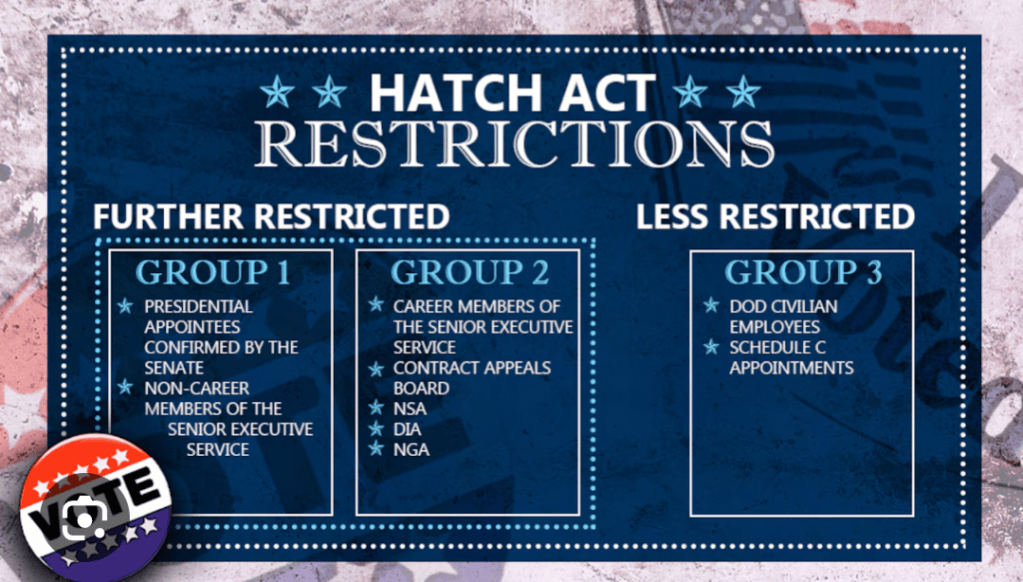
The Hatch Act restricts political activity for most federal employees
- They can’t engage in political activity while on duty, in the workplace, wearing a uniform or official insignia, or in a government vehicle
- They can’t wear, display, or distribute partisan materials or items
- They can’t perform campaign-related chores
- They can’t make political contributions
- They can’t use their official authority or influence to interfere with or affect the result of an election
However, federal employees can:
- Run for office in a nonpartisan election
- Contribute money to political campaigns, political parties, or partisan political groups
- Attend political fundraising functions
- Attend political rallies and meetings
- Join political clubs or parties
In the summer of 2016, PACE TULSA WGS FOUNDATION hosted an online climate assessment survey in the wake of 2015 police excessive force incidents, racial profiling, and highly politicized events.
We began studying, discussing, and giving feedback on local and national topics about Workplace Discrimination: Racism, Sexism, and Wage Retaliation.
Our first pilot forums followed contentious dialogue and heated public debates about American equity and equality. American workers, companies, friends, and families began to engage in workplace issues.
In 2017, legacy employees acknowledged entitlement groups and massive recruitment campaigns. Corporate executive activism guided by emotional invalidation is a divisive strategy employed influencing thoughts, behaviors, and feelings. Reject and dismiss employee concerns by making them feel as if they are gaslighting to keep their jobs.
Internal pool election studies and performance surveys proved senior executives were aware that most entry-level employees onboarding have a distorted reality of the segmented corporation retention aims.
The Work Opportunity Tax Credit (WOTC) is a federal tax credit available to employers who hire people in specific target demographics.
Annual tax exemption credit for each employee in this demographic that often experiences employment barriers by employers.
Work Opportunity Tax Credit employees are equally skilled and qualified subcontracted workers. Companies that do not have equal employment opportunity procedures are flagged at the Department of Labor because staffing solution agencies used to fulfill company staffing needs prioritize placement of WOTC candidates.
- Annual tax exemption credits are for each employee in a qualifying demographic experiencing employment barriers.
Second chance work opportunity credits enable companies to claim a ten thousand dollar tax credit for hiring a marginalized applicant.
Work Opportunities Tax Credit targeted groups align closely with Diversity Equality & Inclusion (D.E.& I.) policy targeted employee groups.
Companies can help satisfy D.E. & I. goals by hiring targeted group employees.
PACE TULSA noticed early separations, terminated or retired employee dissatisfaction was highest among the Work Opportunity Tax Credit (WOTC) employees.
Exit interviews, shift notes, and training meetings are useful filters when researching goal-planning records.
Would marginalized applicants bring anything to the table? As a standard used to compare acceptance and inclusion?
Work opportunity tax credited applicants seek re-enfranchisement in communities that faithfully served them.
Societal-normalizing and good citizenship are effective.
The common ground of Work Opportunity Tax Credit employees – is honesty.
*If I work a 9:00 to 5:00 job
*If I can pay bills on time
*If I can have a car
*If I can have a house
*If I can pay the mortgage and rent
*If I can have a vision, medical, dental, or 401K savings plan and college tuition fund for my children.
*I can regain re-entry into the workforce by competing in training programs.
*I can compete with people more qualified to do the same thing.
*I can train in my community for local corporations.
The mindset of a workforce re-entry applicant includes a clear plan to rise out of poverty and to improve their lives through participation in workforce initiatives.
The decision a work opportunity tax-credited applicant has to make involves regaining trust in a subversive job network that is often unnavigable.
No clear career planning objectives are valued. Logical justice for the WOTC employee is forthcoming. However, employment environments based on deception only help Entitlement Elitists: create non-inclusive acculturation.
Other barriers to employment may exist: Drug addiction; sexual addiction; gang affiliation; domestic assault violence history; or divergent religious and political ties.
Life-enrichment programs powerfully impact people’s lives. Supportive solutions are null and void once a WOTC applicant becomes employed by an Entitlement Elitist: Municipal Occupation Corporation.
Fair wages in the company of bigots and disciples of doom is not an option.
Entitlement Elitists are only on the payroll for Municipal Occupation Corporations as legacy employees because of mastered wage retaliation tactics.
A WOTC employee citing EEOC Labor Laws in a right-to-work at-will state is only cannon fodder in environments of hatred, prejudice, and disrespect.
Human resources WOTC targets are scheduled pathways leading to corporate termination.
Employee engagement is spurious and systemized.
Communication with special-opportunities employees is to identify political or economic stakes.
Upper management is usually persuaded to: talk to WOTC employees about religion, politics, and economics.
Leaders, supervisors, and support.staff may ask workers as a condition of employment to submit shift-hourly or daily reports, emails, and consultation statements about suggested improvements.
Entitlement Elitist legacy employees will even go as far as expressing support for opposing viewpoints about company policies.
Job activities that are encouraged include Worker rallies during and. after work, social events, community fundraisers, and award recognition ceremonies.
Job activities attendance is non-written/ nonverbal compliance.
These job activities are encouraged because they promote company values and foster openness as an extension of dignity.
In most cases, WOTC employees feel their participation is mandatory.
The increased importance of legacy and entitlement employee group politics reflects the jarred door.
The jarred-open door policy is a quietly-quitting phenomenon.
Dozens of professionals, corporate executives, and government affairs staff have exited the workforce seeking a more substantial stake in their careers.
Companies, especially heavily regulated industries, form frontline political reformation networks as a cornerstone of the defense.
Political action staffers never think twice about severing ties with Work Opportunity Tax credit employees, regardless of development training courses and job qualifications.
The employment standard was developed collaboratively by a broad representation of business and labor communities working closely with the Department of Labor, Workers Compensation Board, and U.S. Attorney Office.
The goal was to develop a test standard describing employment relationships across all occupations and industries.
An employment opportunity test standard is guidance when deciding the type of business model that meets their needs.
An individual working relationship or independent contractor employment engagement practices issued are because of equal employment opportunity commission losses rather than employment relationships presumed to be at-will.
The U.S. is one of a handful of countries where employment is predominantly at-will.


2 thoughts on “Entitlement Politics”