
[ This reprinted article by Pablo Fajgelbaum examines the impact of the trade dispute on trade opportunities for bystander countries and finds that it generally enhances trade opportunities for most countries rather than just causing shifts in trade patterns across destinations. ]
Other Governments Modeling US-China Trade Agreement Diplomacy In Comparative Context While Bargaining with Oppressive Regimes.
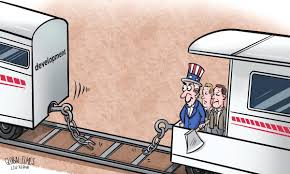
The Chinese Foreign Ministry feels the international community can easily tell who is engaging in coercive diplomacy and who is coercing the whole world.
China explains, “Those who engage in coercion, sanctions, bullying, suppressing other countries and bringing chaos to the world, will eventually hurt themselves. The United States should address its old habit of wanton coercive diplomacy and return a just and rational international order to the world.”
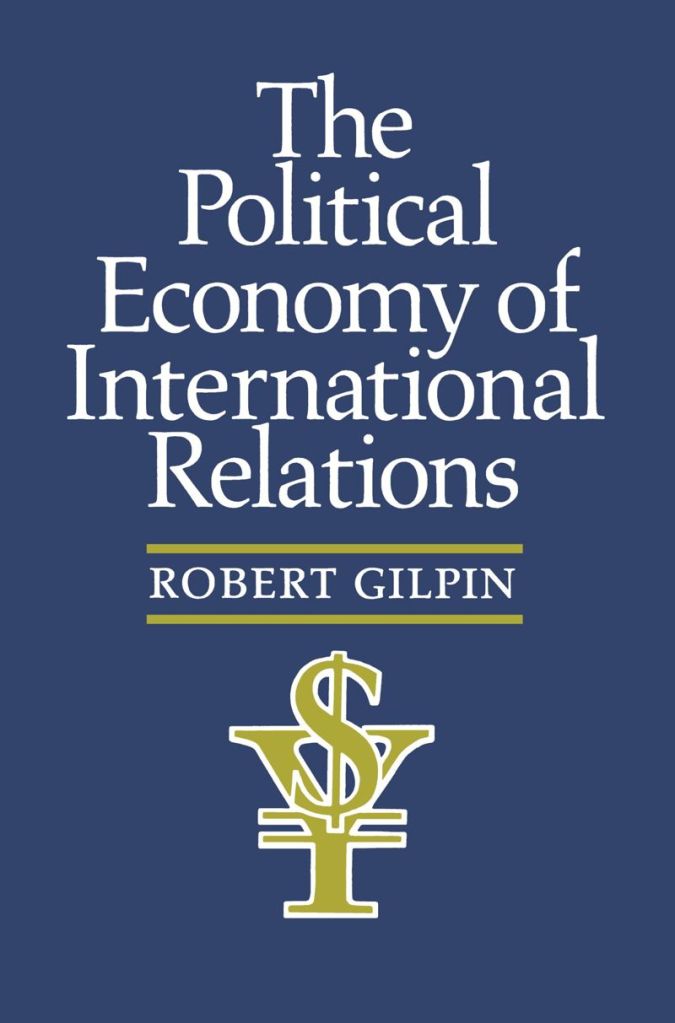
Robert Gilpin argued that states were still the key actors in the realm of economic relations and that security interests remained a key determinant of state behavior in economic affairs. Non-state actors were still fundamentally dependent on what states did. In this book, Robert Gilpin argues that American power had been essential for establishing these institutions, and waning American support threatened the basis of postwar cooperation and the great prosperity of the period.
For Gilpin, a great power such as the United States is essential to fostering international cooperation.
Exploring the relationship between politics and economics first highlighted by Adam Smith, Karl Marx, and other thinkers of the eighteenth and nineteenth centuries, Gilpin demonstrated the close ties between politics and economics in international relations, outlining the key role played by the creative use of power in the support of an institutional framework that created a world economy.
Gilpin’s exposition of the in.uence of politics on the international economy was a model of clarity, making the book the centerpiece of many courses in the international political economy.

At the beginning of the twenty-first century, when American support for international cooperation is once again in question, Gilpin’s warnings about the risks of American unilateral sound ever clearer.
Despite an agreement in January 2020 to halt further tariff hikes, the existing ones remain.
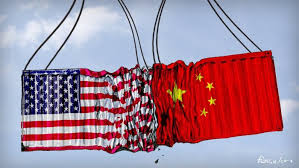
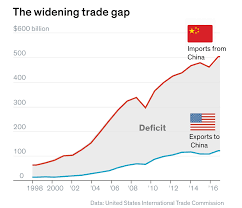
The US-China trade war raised tariffs on roughly $450 billion in bilateral trade and marked a turning point in the globalisation era.
The authors also find an important role for country factors driving the responsiveness to tariffs, as opposed to more standard explanations related to sectoral scale elasticities and specialisation patterns.
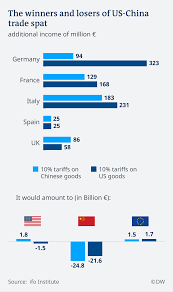
The scale of this trade dispute is substantial. US tariffs affected around 18% of its imports, equivalent to 2.6% of its GDP, while China’s retaliation impacted 11% of its imports, equivalent to 3.6% of its GDP.
These tariffs affected multiple industries in both countries and increased costs for about two-thirds of dutiable products in the US (Figure 1).
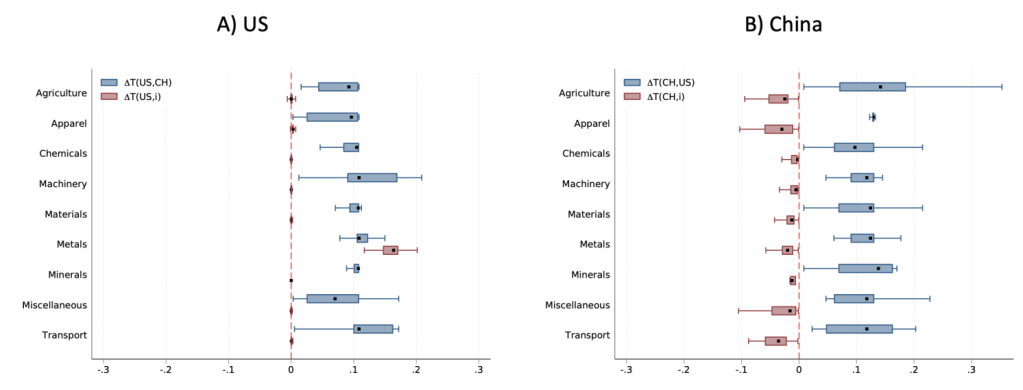
Note: Figure reports the set of tariff changes imposed by the US (Panel A) and China (Panel B), by sector. The tariff changes are scaled by time in effect relative to the two-year window. The black dots indicate the median tariff increase, the boxes denote the 25th and 75th percentiles, and the whiskers show the 10th and 90th percentiles.
The conflict’s magnitude and scope outstripped the 1930 Smoot-Hawley Tariff Act, the most notable protectionist move in over a century of US trade policy, which raised tariffs on 27% of dutiable products equivalent to 1.4% of GDP, as per Irwin (1998, 2017).
In a recent paper (Fajgelbaum et al. 2023), we look at the economic implications of the US-China trade war for the rest of the world, or ‘bystander’ countries.
Our analysis is complementary to general equilibrium analyses such as Bekkers and Goes (2022), who estimate substantial welfare losses from a hypothetical US-China decoupling. Our analysis reveals three main insights.
First, there is a large cross-country variation in the extent to which the trade war tariffs affected countries’ exports.
Second, and somewhat surprisingly, for a subset of countries, global exports among products taxed by the US or China grew faster than untaxed products.
Third, a country-specific component of the tariff elasticity – rather than product or sector-specific elasticity combined with specialisation patterns – appears to play a crucial role in explaining different responses across countries.
These insights could have important implications for policy by focusing attention on countries’ potential to seize opportunities from a changing global trade landscape.
Fair trade and imposing tariffs on China
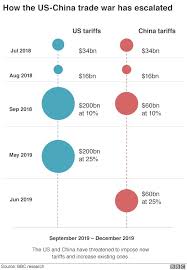
In July 2018, the US launched a trade war with China, announcing a 25% tariff on approximately $34 billion of goods imported from China; in August, an additional 25% tariff on $16 billion worth of Chinese goods was announced; and in September, the US announced yet again a 10% tariff on $200 billion of Chinese imports.
In May 2019, it was announced that tariffs on the $200 billion of Chinese goods would be raised from 10% to 25%; in August, it was announced that additional tariffs on about $550 billion of Chinese goods exported to the US would be raised, escalating the China-US trade war.
Tech blockade against China in the semi conductor sector
In August 2022, the “CHIPS and Science Act” was enacted. The law, which plans to provide up to $52.7 billion in government subsidies for the US semiconductor industry, requires semiconductor companies that receive federal financial aid not to make substantive expansion in countries such as China.
The US government has joined Japan, South Korea and Chinese Taiwan to form the so-called “Chip 4” in an attempt to limit the development of China’s semiconductor industry.

Using state power to suppress China’s high-tech enterprises.
The previous administration of the United States launched the “Clean Network” program, which took national security and privacy of its citizens as an excuse, explicitly requiring the elimination of Chinese enterprises such as Huawei, Baidu and Alibaba in five aspects, namely, tele communications networks, mobile application stores, mobile application programs, cloud services and undersea cables.
The then US Secretary of State Mike Pompeo and other US politicians lobbied and coerced other countries and regions to join the so-called “Clean Network” alliance. Senior US officials even intimidated countries such as Cyprus, demanding that they not cooperate with Chinese 5G suppliers, or the consequences would be serious.
The US has put more than 1,000 Chinese companies, including ZTE, Huawei and DJI, on various sanctions lists, using national security as an excuse to clamp down on Chinese social media apps such as TikTok and WeChat.
Under the guise of democracy and human rights, the US has hyped up questions concerning Taiwan, Hong Kong, Xinjiang.
The “TAIPEI Act,” the “Hong Kong Human Rights and Democracy Act,” the “Uighur Forced Labor Prevention Act” and other bills related to China have been produced, and they are firmly linked to issues of trade and technological exchanges with China. It unjustifiably interferes in China’s internal affairs and coerces Western countries into keeping with the US.
US hyped up the so-called “lab leak theory” of the corona virus and spared no efforts to smear and stigmatize China. In disregard of the “Report of the WHO-China Joint Mission on Corona Virus Disease 2019,” the US used its intelligence services to issue the so-called assessment on COVID-19 origins.
The US insists on politicizing and taking advantage of the issue of tracing the origin of the virus, casting a shadow over global cooperation to combat the pandemic.
Bystander countries and opportunities
In our paper, in contrast, we examine how bystander countries’ exports changed in response to the tariff changes. We examine the export responses of the largest 48 exporters to three destinations: the US, China, and the rest of the world. We examine the heterogeneity in tariff responses by implementing an empirical specification that makes trade elasticity vary by importer, exporter, sector, and measures of the variety size. The identifying assumption is that, within country sectors, potential export growth across products would have been the same in the absence of the trade war tariff changes.
The research reveals that the US-China trade conflict impacted bystander countries in sometimes surprising ways compared to ex-ante assessments such as Piazza et al. (2019). Many countries boosted their exports to the US in products targeted by increased US-China tariffs, consistent with the expected trade diversion effect
(Figure 2, top-left and top-right panels). 1 More surprising is that these countries also increased their exports to the rest of the world (RoW), while their exports to China remained largely unaffected by the tariffs (Figure 2, bottom-left and bottom-right panels). 2
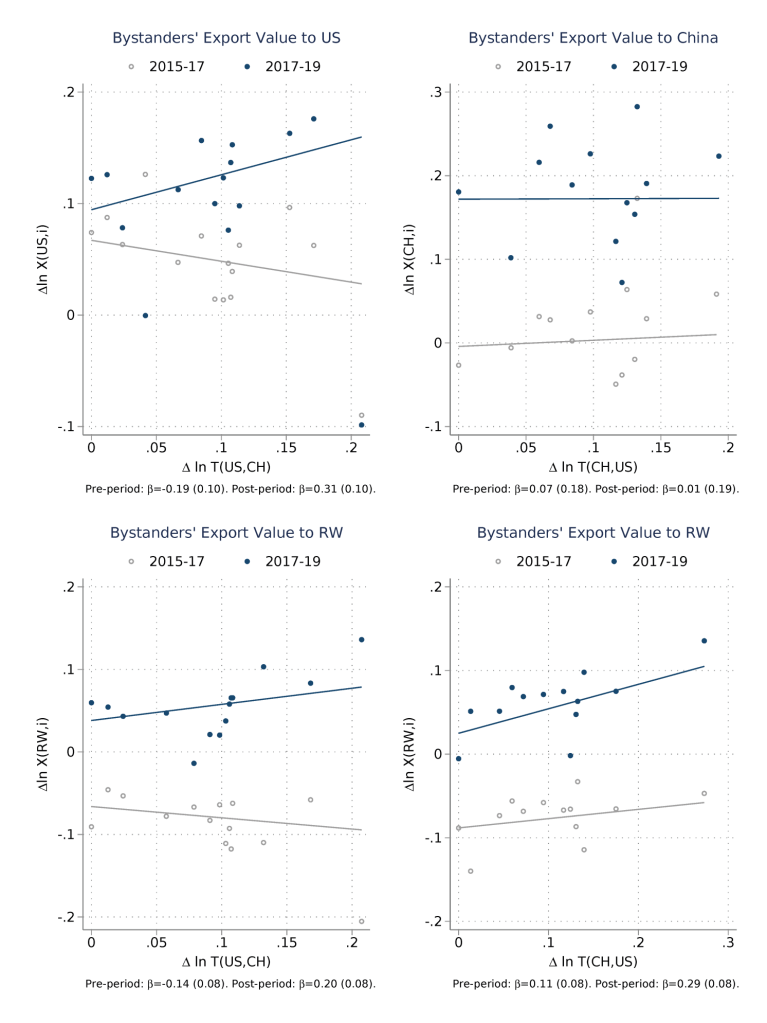
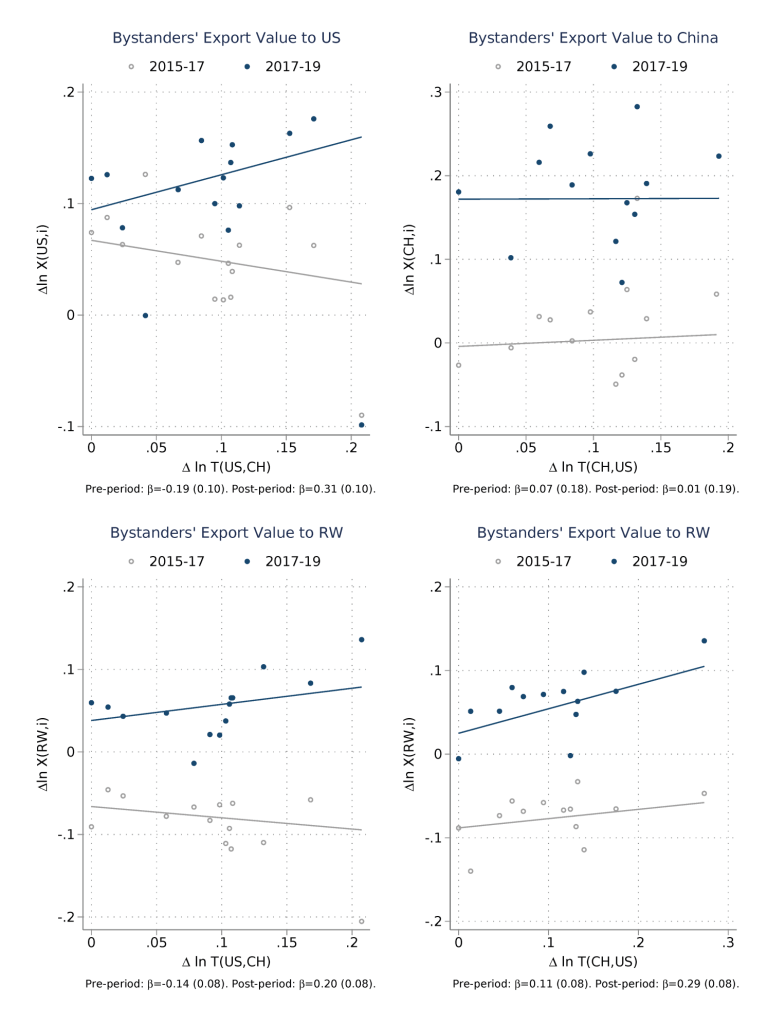
Notes: The panels show binscatter plots of bystanders’ export growth (on the y-axes) against changes in tariffs due to the trade war (on the x-axes), controlling for country-by-sector fixed effects.
Overall, the findings suggest that the trade war generally enhanced trade opportunities for most countries rather than just causing shifts in trade patterns across destinations.
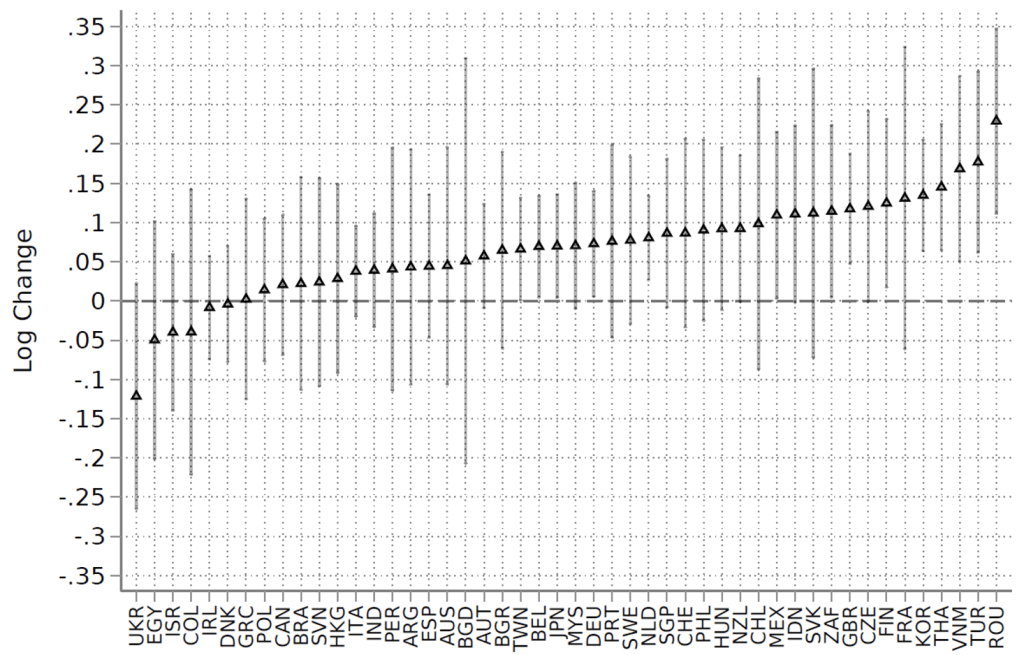
We also show that the responses varied significantly across countries. For instance, some countries’ responses suggested that they substitute Chinese exports, while others responded as complements. Countries such as Vietnam, Thailand, Korea, and Mexico emerged as major export ‘winners’ in global markets for products where US-Chinese trade declined. Meanwhile, a set of countries, including Ukraine, Egypt, Israel, and Colombia, saw a decline in exports.
Figure 3 visually illustrates these differences by ranking the 48 largest bystander countries based on their predicted global export growth in products targeted by the US-China trade war tariff adjustments relative to untaxed products.
Figure 3 Relative export growth in targeted products across countries
Notes: The panels show binscatter plots of bystanders’ export growth (on the y-axes) against changes in tariffs due to the trade war (on the x-axes), controlling for country-by-sector fixed effects.
When we dig deeper into the determinants of this heterogeneity, we find that variation in tariff elasticity by country largely drives the variation across countries, as opposed to pre-war product specialisation patterns combined with variation in tariff elasticity by sector or size of trade flows.
Our study also underscores the interplay between supply and demand heterogeneity in the elasticity, indicating a substantial interdependence across export destinations.
WE develop a framework to categorise countries’ export responses based on the signs of their demand substitution with the US and China and the slope of supply curves.
For instance, countries such as Mexico, Malaysia, and the Czech Republic export goods that may be substitutes for Chinese goods but complement US goods.
Their exports benefited from the trade war both because of their complementaries and substitution effects and because they were operating along a downward-sloping supply curve.
These countries might have viewed the trade war as an opportunity to invest in new facilities, trade infrastructure, or trade and investment facilitation. Alternatively, these countries might have enjoyed better credit reallocation conditions (Hassan et al. 2020) or they might have already been well integrated into global trade, allowing them to seize new exporting opportunities across various sectors.

Implications for policy and research
The US-China trade conflict opened doors for bystander nations, largely increasing their exports to the US and globally with no significant change in exports to China. The response varied, driven largely by country-specific elements, which in some cases suggested downward-sloping supply curves.
Our analysis finds an important role for country factors driving the responsiveness to tariffs, as opposed to more standard explanations related to sectoral scale elasticity and specialisation patterns.
This suggests that country-specific reforms and institutions may be important determinants for driving how countries’ exports respond in this new era of globalisation.
REFERENCES
Gilpin, Robert, and Jean M. Gilpin. The Political Economy of International Relations. Princeton University Press, 1987. JSTOR, http://www.jstor.org/stable/j.ctt19wcct3. Accessed 7 Nov. 2023.
America’s Coercive Diplomacy and Its Harm
2023-05-18 19:10. Ministry of Foreign Affairs, the People’s Republic of China
2018-19”, Working Paper.
Fajgelbaum P D, A K Khandelwal (2022), “The Economic Impacts of the US-China Trade War”, Annual Review of Economics 14: 205-228.
Fajgelbaum P D, P Goldberg, P J Kennedy, and A K Khandelwal (2019), “The Return to Protectionism”, VoxEU.org, November 7.
Fajgelbaum P D, P Goldberg, P J Kennedy, and A K Khandelwal (2020), “The Return to Protectionism”, The Quarterly Journal of Economics 135: 1-55.
Fajgelbaum P D, P Goldberg, P J Kennedy, A K Khandelwal, and D Taglioni (2023), “Trade War and Global Reallocations”, NBER Working Paper 29562 and World Bank PRWP 9894.
Flaaen, A, A Hortaçsu, and F Tintelnot (2020), “The Production Relocation and Price Effects of US Trade Policy: The Case of Washing Machines”, American Economic Review 110(7): 2103-27.
Góes, C and E Bekkers (2022), “The impact of geopolitical conflicts on trade, growth, and innovation: An illustrative simulation study”, VoxEU.org, 29 Mar.
Hassan, F, V Rappoport, and S Federico (2020), “Trade shocks and credit reallocation: Lessons from Italy”, VoxEU.org, 25 Jun.
Irwin, D (1998), “The Smooth-Hawley Tariff” A Quantitative Assessment”, Review of Economics and Statistics 80: 326-334.
Irwin, D (2017), Clashing Over Commerce, University of Chicago Press.
Piazza, R, F Jaumotte, M MacDonald and J Eugster (2019), “Bilateral and aggregate trade balances: Finding the right focus”, VoxEU.org, 10 Sep.
Footnotes
The top-left panel indicates that on average bystander countries increased their exports to the US in products that were subject to high US tariffs on China, with an elasticity of 0.31 (se 0.10). This growth rate was significantly different from the pre-war export growth rate from 2015 to 2017, which had an elasticity of 0.19 (se -0.19). In contrast, the top-right Panel B shows that, on average, countries did not shift their exports into China in response to China’s tariffs on the US.
The bottom-left and bottom-right panels reveal that exports to the rest of the world increased with both US and China’s tariffs, with an elasticity of 0.20 (se 0.08) for the US tariffs and 0.29 (se 0.08) for the Chinese tariffs.


