

| Reprint – Joint Economic Committee United States Congress. June 2016 |
Fact-checking groups have investigated similar statements and have found time and time again that they are true. Moreover, past research shows that stock market returns are also higher under Democrats.
Completely Attributable To Policy Choices
The Economy Under Democratic vs. The Republican Party claims to be “the party of maximum economic freedom and the prosperity that freedom makes possible.” However, an analysis of economic performance since World War II under Democratic versus Republican presidents strongly suggests that claims that Republicans are better at managing the economy are simply not true.
While the reasons are neither fully understood nor completely attributable to policy choices, data shows that the economy has performed much better during Democratic administrations.
Economic growth, job creation and industrial production have all been stronger. In fact, a recent paper by economists Alan Blinder and Mark Watson states: “The superiority of economic performance under Democrats rather than Republicans is nearly ubiquitous; it holds almost regardless of how you define success.”
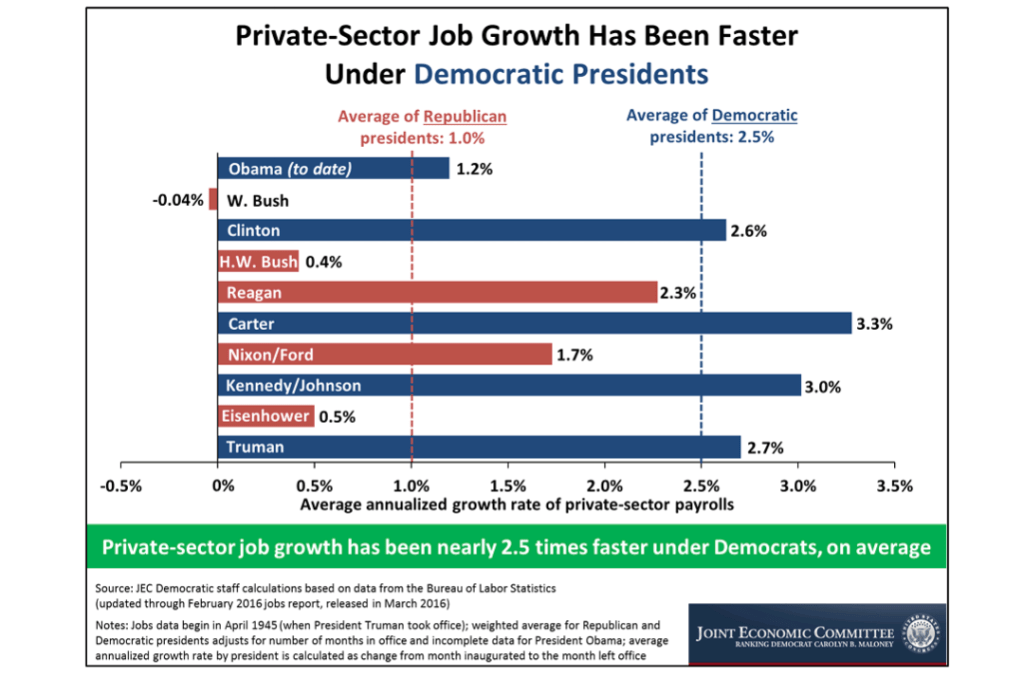
The findings for private-sector job growth are even more striking: businesses have added jobs at a nearly 2.5 times faster rate under Democrats than under Republicans, on average.
In fact, the private-sector job growth gap between Democrats and Republicans is even greater than the gap when including government jobs.
The Blinder and Watson paper concludes that the “large and significant” performance gap between the economy under Democrats and Republicans is predominantly due to factors that “might be considered blends of good policy and good luck,” in particular lower oil prices and higher productivity growth. But as Dr. Blinder pointed out to FactCheck.org, presidents may inadvertently affect these factors while pursuing other objectives. For example, he wrote: “the fact that we entered several wars in the gulf area (the latest in 2003) under Republican presidents, thereby driving up oil prices, was not just luck – it was policy, though not economic policy.”
These results should be interpreted with caution, since numerous external factors can impact the economy, including demographic trends, the strength of foreign economies and actions by the Federal Reserve.
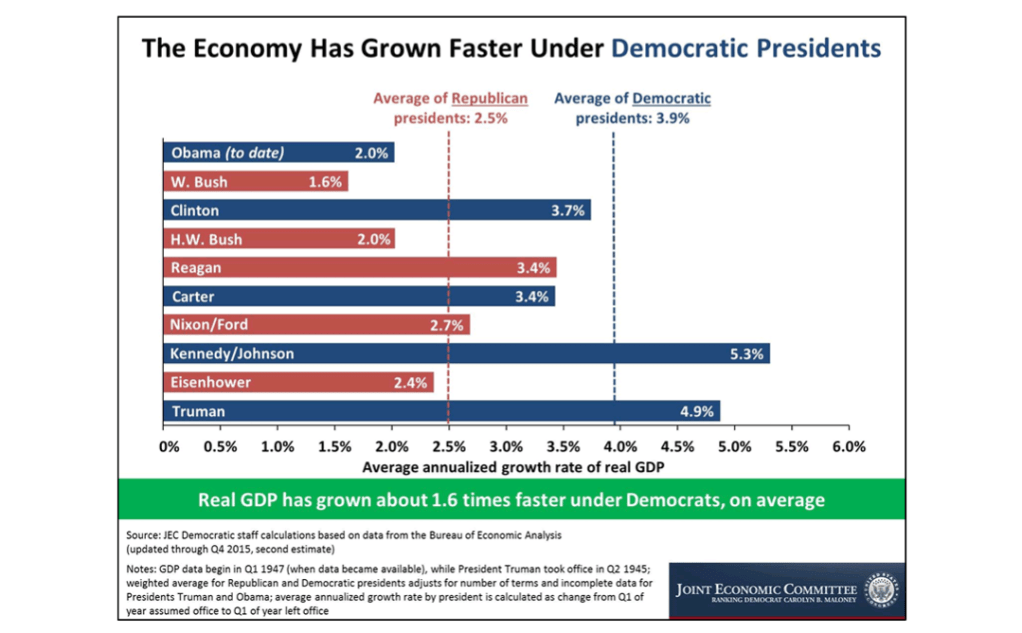
The charts in this document update and expand upon the analysis in the Blinder and Watson paper. They include more recent data for both gross domestic product (GDP) and employment, as well as revisions to past data that have occurred since their paper was written. The charts also go back further to include all available data for the Truman presidency, though GDP data are only available beginning in 1947.
The data shows that, since World War II, the economy has performed substantially better under Democratic presidents. On average, real (inflation-adjusted) GDP has grown about 1.6 times faster under Democrats than under Republicans. While the strong performance under Presidents Truman, Kennedy and Johnson certainly contributes to this gap, the starting point does not matter:
GDP has grown faster under Democrats regardless of whether the analysis begins with President Truman, President Kennedy or President Reagan. The findings for private-sector job growth are even more striking: businesses have added jobs at a nearly 2.5 times faster rate under Democrats than under Republicans, on average. In fact, the private-sector job growth gap between Democrats and Republicans is even greater than the gap when including government jobs.
Blends of good policy and good luck
The concept of legacy employment as a brand has been an industry standard for decades.
Companies that follow this brand tend to have long-tenured leaders that persist through technological changes and industry trends.
Companies placing a high-value on job tenure, refers to time an employee has worked for their current employer.
Long-tenured employees typically have worked for a company for more than five years.
Many employers consider tenure to be an essential criterion for hiring new employees, as it can have a significant positive impact on financial performance and operational excellence.
Long tenured employees are more likely to have a deep understanding of their company’s culture, processes, and values, which can help them make better decisions and achieve better results.
It is important to note that an employee’s age doesn’t impact business performance.
What matters is the employee’s skills, experience, and ability to adapt to changes.
Youthful employees, may be more innovative and tech-savvy than some older employees.
Major tech companies like Google and Amazon have an average tenure of two years, whereas legacy providers like HP and IBM retain more tenured workers.
The employees at Hewitt Packard stay for an average of six years, while employees at International Business Machines stay for an average of seven years.
This data indicates that legacy employment as a brand is relevant and attractive to some employees.
A rise of new technologies and work models create opportunities for older employees.
More experience and wisdom signal a willingness to navigate complex situations.
However, some companies may try to force out older employees for various reasons, including downsizing and cutting labor costs.
Labor cuts can be unfair and demotivating for employees who have dedicated many years to their company and have valuable skills and knowledge.
Companies should strive to balance their short-term financial goals with their long-term human capital strategies, which require them to retain, develop, and engage their employees.
The reasons why an employee is not getting a promotion can vary.
There may be a need to improve work performance and earn several excellent performance reviews.
There may be a need to change one’s attitude and behaviors, which affect relationships with colleagues or superintendents.
Additionally, there may be external factors that limit the chances of promotion, such as a lack of available positions, a lack of skills or experience required for a higher position, or a lack of support from one’s personal or professional network.
To increase the chances of getting promoted, employees should take several steps.
Thank your manager.
Ask for support after completing small tasks.
Demonstrate eagerness to learn and improve.
Cite development plans.
To demonstrate ambition and potential, tracking personal development trends, monitoring achievements, and the impact it has on your group.
Stay focused on oneself and one’s goals, giving oneself a pat on the back to boost self-esteem and confidence, and openly discussing options with one’s manager or HR representative to demonstrate a willingness to take on new challenges and responsibilities.


