

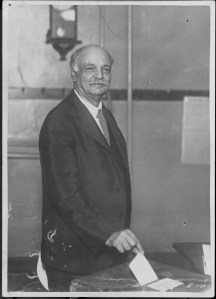
(1860-1936) casts a vote in the
US Senate in 1929.
kansasmemory.org,
Kansas State Historical Society,
Born in 1860, Curtis was proud of his Kansas roots, as is clear from his personal papers located in the Kansas Historical Society. He grew up speaking both Kansa and French, before he learned English, and he remained close to his Indigenous relatives and the Kaw nation. Curtis may be most notable for his political career, which spanned six terms as a congressman (1892–1907) and 20 years as a senator (1907–13, 1915–29), where he served as the Republican Party whip and majority leader. In 1928, he was elected as Herbert Hoover’s vice president. He was also the first person of color to serve as Vice-President of the United States.
Curtis’s most lasting legacy, certainly for scholars of American Indian history, is the Curtis Act. The 1898 Curtis Act amended the Dawes Act of 1887, which gave the federal government the power to break up tribally held lands. Most federal Indian policy officials interpreted this law as dismantling Indigenous claims to communally owned land and encouraging the incorporation of Native people into American society by incentivizing “improvements” they made to the land allotted to them. Any “surplus” land—which was not allotted to tribal people—was available for sale to non-Natives. Before any of this newly private property was allotted, the government created a process by which it would determine which Native people were eligible to receive land. This resulted in the creation of a federal definition for Indian identity, a policy that extended the federal government’s interventions into the lives of Native people as its perceived “wards.”
Twelve years later, the Curtis Act extended allotment to the Five Tribes—the Choctaw, Chickasaw, Cherokee, Muscogee (Creek), and Seminole living in Oklahoma—who had been exempted from the 1887 act. As a Kansas representative in Congress and a Kaw citizen, Curtis authored the law, which was officially titled “An Act for the Protection of the People of Indian Territory, and For Other Purposes.” The title embodies a paternalistic discourse that pervaded federal Indian policy at the time. Despite his name being attached to it, Curtis wrote in his autobiography about being unhappy with the final version.
In the hearts of the fellow citizens in neighborhoods — the politicians will judge the more just State(s) that is police-fascist in nature, but rather, paradoxically, stage events more exhibiting brutal police force signaling its’ use as the measure needed to create stability. And as civility crumbles and the police situation worsen — the police become defenders of a banner against violence stemming from revolting revolutionaries.
The police make it possible for the State to exist. Where the State is weak, the police act even more brutally than usual. This school of thought itself is disciplinary in marginalized neighborhoods. Visually thought-out intelligences, see sharp inability of the legal system to control police action. Police action can become so brutal that it erodes love for the State.
Another grant of excessive law enforcement power stripped away from police agencies will decrease nationalist love for the State and Snowball into Lawlessness?
The 10th U.S The Circuit Court of Appeals, issued its decision on Wednesday, rejecting Tulsa, Oklahoma’s argument that the Curtis Act, an 1898 federal law passed before Oklahoma became a state, gave Tulsa jurisdiction over municipal violations committed by Native Americans.
This is what Governor Stitt had to say about the decision:
“I am extremely disappointed and disheartened by the decision made by the Tenth Circuit to undermine the City of Tulsa and the impact it would have on their ability to enforce laws within their municipality. However, I am not surprised as this is exactly what I have been warning Oklahomans about for the past three years. Citizens of Tulsa, if your city government cannot enforce something as simple as a traffic violation, there will be no rule of law in eastern Oklahoma. This is just the beginning. It is plain and simple, there cannot be a different set of rules for people solely based on race. I am hopeful that the United States Supreme Court will rectify this injustice, and the City of Tulsa can rest assured my office will continue to support them as we fight for equality for all Oklahomans, regardless of race or heritage.”
When we examine culpability of addressing police misconduct laws enforced by the Department of Justice and Municipal Authorities et al en sequitur meaning: “the one thing following logical consequence,” there are and always have been Federal laws that address police misconduct including both criminal and civil statutes.
These laws cover the actions of State, county, and local officers, including those who work in prisons and jails. In addition, several laws apply to Federal law enforcement officers. Moreover, the laws protecting all persons in the United States (citizens and non-citizens).
Hooper is going to “snowball into societal lawlessness.” is an over-reach
Violence authorized by the State to shore up respect for its laws is never a positive right.
The Fourteenth Amendment, Section 1 reads:
All persons born or naturalized in the United States, and subject to the jurisdiction thereof, are citizens of the United States and of the State wherein they reside. No State shall make or enforce any law which shall abridge the privileges or immunities of citizens of the United States; nor shall any State deprive any person of life, liberty, or property, without due process of law; nor deny to any person within its jurisdiction the equal protection of the laws. This also, according to the State includes the police state. Police officers, in addition to embodying the State, embody the defense of private property (against “property crimes,” as one says of the charges often filed against demonstrators). They confer reality on the idea of private property, just as they do for the idea of the state. The defense of private property also systematically drives the police to practice ethnic discrimination.
Here are some facts from the case:
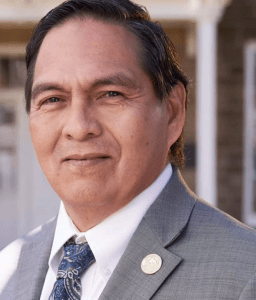
Justin Hooper, a citizen of the Choctaw Nation, was cited for speeding in 2018 by Tulsa police in a part of the city within the historic boundaries of the Muscogee (Creek) Nation. He paid a $150 fine for the ticket, but filed a lawsuit after the U.S. Supreme Court’s ruling in McGirt v. Oklahoma.
Justin Hooper, a citizen of the Choctaw Nation, argued that Tulsa did not have jurisdiction because his offense was committed by a Native American in Indian Country.
A municipal court and a federal district court judge both sided with Tulsa, but a three-judge panel of10th Circuit reversed the lower court’s decision.
The court’s ruling was based on the U.S. Supreme Court’s landmark 2020 decision that found that much of eastern Oklahoma, including Tulsa, remains an Indian reservation because it was never formally disestablished by Congress.
Tribal Nations are celebrating another win in federal court, following a ruling that a Choctaw citizen was improperly prosecuted for a speeding ticket in Tulsa.
The City of Tulsa argued it should have the ability to prosecute Native Americans in the wake of the McGirt v. Oklahoma decision because of a pre-statehood law known as the Curtis Act, which was meant to force allotment on tribal nations to make way for statehood.
Tulsa argued that Section 14 of the act was never repealed by Congress and that it gave them the authority and criminal jurisdiction.
The decision was immediately derided by Oklahoma Gov. Kevin Stitt
A Republican who is a citizen of the Cherokee Nation, but has had an increasingly hostile relationship with the state’s Native American tribes that stems from a feud over tribal casinos.
The purpose of policing has something vague and unreal about it.
Was it real, it would demand our utmost attention, for a concept of justice and the public good is not an easy thing to think up? The existence of the police is palpable, obvious, and requires no effort to be recognized. So, it seems obvious that policing is an end unto itself.
It is an easy leap to make. We simply posit as an axiom that the sole condition, both necessary and sufficient, under which the police can meaningfully contribute to justice and the public good that it allegedly exists to serve is that they first be granted a large amount of power. The power in question is what we commonly refer to as “the legal monopoly of public force, the violence authorized by the State to shore up respect for its laws.”
No fixed amount of such power could ever be considered enough, especially once it has been obtained.
Police understand themselves as serving not simply the laws of the nation, but justice. As a result, they feel they are kept in a condition of impotence, never given enough power.
Since the police believe they serve justice and not merely law, police believe they’re out to protect the widow and the orphan—or in any case, we attribute such thoughts to them. The essential tendency of policing is totalitarian.
It is precisely because the idea of justice and the public good that policing depends upon is a fiction, an imaginary thing divorced from reality, that it can provoke a quest for absolute power.
That which has no existence can never be delimited. To believe that the State limits the police is to believe, quite simply, that the State is more real than the police, when in fact the police are the very embodiment of the State, its most palpable presence in everyday life.[1] https://theanarchistlibrary.org/library/anonymous-manifesto-for-the-abolition-of-the-police


