
Operational excellence (OpEx) is a business management philosophy that aims to improve a company's performance by making daily operations more efficient and effective. It involves a culture of continuous improvement, standardized processes, increased productivity, and waste reduction.
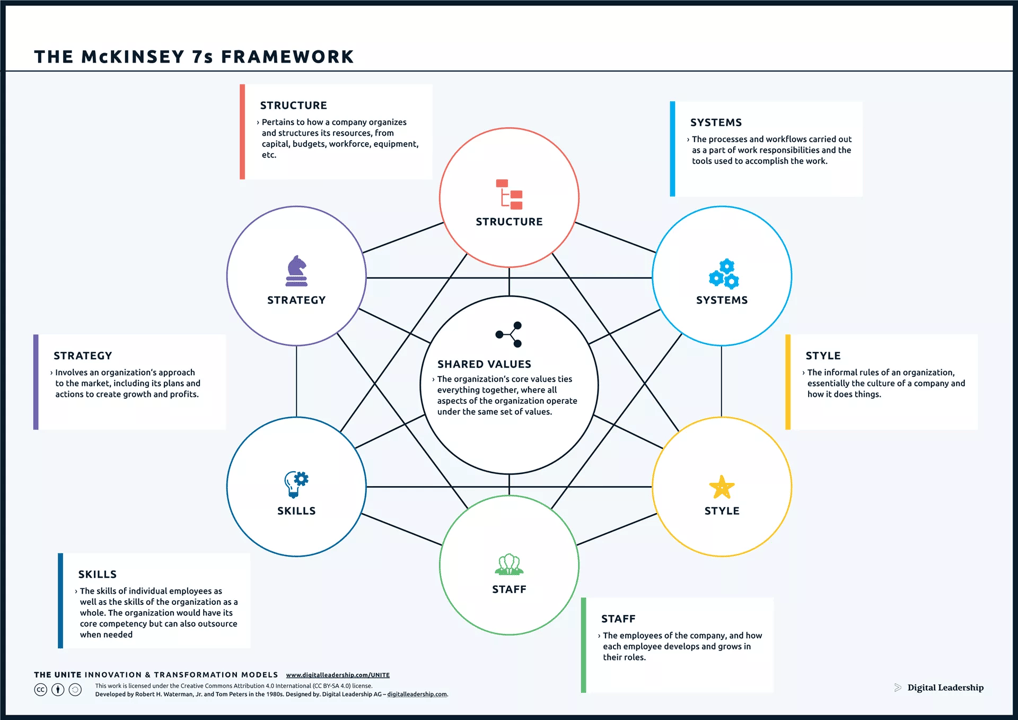


The McKinsey 7S framework
The McKinsey 7S framework is not merely a change management model; rather, it is intended to drive organizational excellence. It was introduced in the book “In Search of Excellence” by Tom Peters and Robert Waterman.
Since its publication, there have been revelations that some of the data in the book was falsified… Additionally, some organizations initially praised as excellent based on this model have since fallen out of favor.
Despite these drawbacks, the framework highlights seven critical factors of organizational success that can be fine-tuned to enhance organizational agility.
The Operational Excellence Model in Transportation Policy is essential because it governs several key principles pivotal to its success. These principles include customer focus, process optimization, data-driven decision making, and employee empowerment. By adhering to these principles, organizations can drive several benefits such as improved efficiency, enhanced quality, increased agility, innovation, and growth.
Seven Ss
The seven Ss are broken into two basic categories: those that are considered hard, and those that are considered soft. The hard Ss, which are easier to manage and monitor, are:
- Strategy – The purpose of the business and the approach to success.
- Structure – The division of work and activities throughout the organization.
- Systems – The procedures that are used to ensure repeatability. (See The E-Myth Revisited for more about systemization.)
The soft Ss, which are more difficult to manage in a single, understandable way, are:
- Shared Values – The values that the organization strives for collectively.
- Skills – The capabilities and capacities of the organization both in its people and in aggregate.
- Style – The typical behavior patterns – the culture.
- Staff – The people in the organization, including their unique experiences and perspectives.
Relating
The significant innovation in the model lies in the interconnected nature of its factors. It explicitly recognizes that changes made in one area will inevitably affect other areas. This interconnectedness makes it challenging to enhance organizational performance and sustain performance improvements.
Furthermore, the precise nature of these factors and how to manage them more effectively is not clearly identified. While the framework emphasizes the importance of these factors, it does not specify what they should be or how to exert influence over those factors.
Actionability
One of the difficulties with all non-linear change models, especially the McKinsey 7S framework, is the challenge of turning it into actionable steps. While it may be interesting and even useful to understand the framework, comprehension of the model alone does not necessarily lead to improved organizational performance, increased agility, or successful project implementation.
The most beneficial use of the model lies in evaluating how each change will affect the other areas of the model. For instance, how would altering the staff impact the overall strategy, and vice versa?
Criticisms
As previously mentioned, Peters admitted that some of the data was falsified, and the organizations purported to be excellent quickly lost favor. However, the main criticisms of the model revolve around its capacity to be translated into a set of actionable steps for enhancing organizational performance or implementing change.
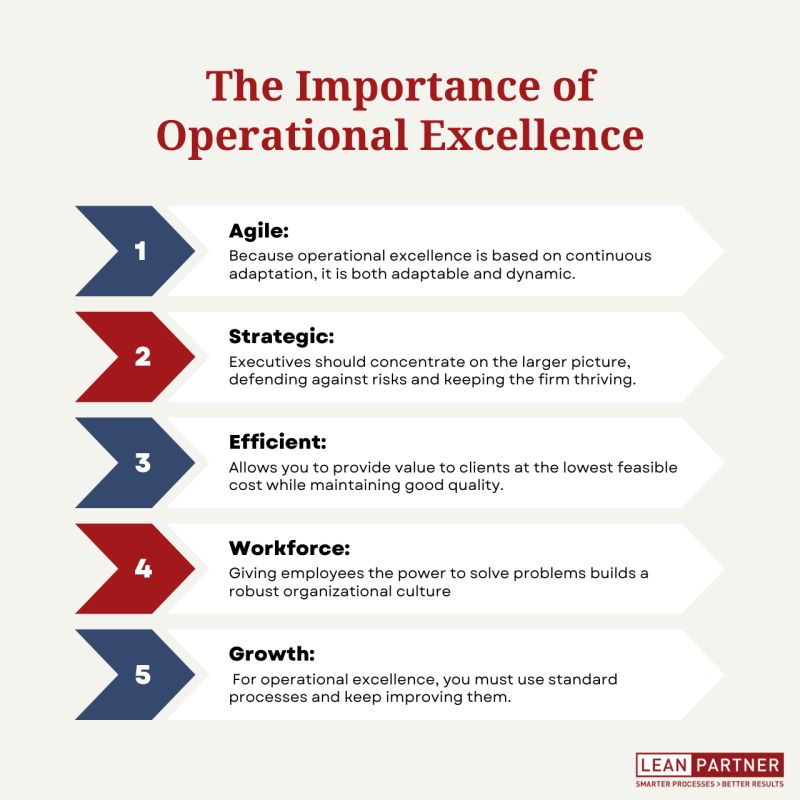
Operational Excellence is not confined to a specific industry or sector
Operational Excellence is not confined to a specific industry or sector; instead, it can be applied across various business functions within the transportation policy. This model plays a vital role in driving efficiency and effectiveness in the transportation sector, leading to improved service delivery and customer satisfaction.
The journey towards Operational Excellence is a meticulous process
The journey towards Operational Excellence is a meticulous process that demands careful planning, execution, and continuous improvement. Transportation Policy Organizations can implement operational excellence by following key steps such as assessment, defining objectives, process mapping, change management, training and development, and continuous improvement. However, implementing operational excellence is not without its challenges. Common hurdles include resistance to change, limited resources, and organizational silos. Overcoming these challenges requires strong leadership, effective communication, and a commitment to cultural transformation.
The impact of Operational Excellence on business transformation
The impact of Operational Excellence on business transformation is significant. It drives business efficiency, fosters innovation, and enables organizations to measure their success through key performance indicators (KPIs) such as cost of quality, on-time delivery, customer satisfaction, process efficiency, and continuous improvement.

Sustaining success in operational excellence
Sustaining success in operational excellence necessitates a commitment to continuous improvement. This involves regularly reviewing processes, engaging employees, and leveraging technology to drive innovation and adapt to changing market dynamics. Looking ahead, future trends in operational excellence are expected to be shaped by automation, artificial intelligence, data analytics, and the impact of the COVID-19 pandemic.
Additional Principles of Operational Excellence
Operational Excellence encompasses various interpretations, all centered on optimizing the delivery of value to customers through ongoing enhancements across all organizational levels.

The Shingo Institute at Utah State University
The Shingo Institute at Utah State University, named after Shigeo Shingo, a Japanese industrial engineer renowned for documenting the Toyota Production System, advocates for a set of 10 guiding principles for Operational Excellence:
1. Respect for every individual
2. Leading with humility
3. Pursuit of perfection
4. Embracing scientific thinking
5. Focus on process
6. Ensuring quality at the source
7. Improving flow and pull
8. Thinking systematically
9. Creating constancy of purpose
10. Generating value for the customer
The Shingo Institute recognizes organizations that achieve business improvements guided by these 10 core principles.
Operational Excellence underscores the flow of value to the customer
Similarly, the Institute for Operational Excellence underscores the flow of value to the customer and defines the core principles of Operational Excellence as follows:
1. Designing lean value streams
2. Facilitating lean value stream flow
3. Visualizing flow for employees
4. Establishing standard work for flow
5. Visualizing abnormal flow
6. Developing standard work for abnormal flow
7. Empowering employees within the flow to enhance the flow
8. Executing offensive (growth) activities
A crucial point to remember is that implementing change
Many enterprises opt to utilize established methodologies such as Lean, Six Sigma, Total Quality Management, or Kaizen to align with the principles of Operational Excellence.
A crucial point to remember is that implementing change, especially continuous change, presents significant challenges.
According to an IBM study, 60% of change initiatives do not meet their objectives. Moreover, research from McKinsey & Co. paints an even bleaker picture, revealing that only 26% of organizational transformation endeavors succeed. However, the positive news is that technology is making this process more manageable.
Sphera has observed that Digital Transformation is assisting companies in enhancing prioritization and planning, establishing crucial performance indicators and metrics, and providing predictive insights to drive future improvement initiatives.
Through the utilization of Operational Excellence software and consulting services that offer an integrated approach to risk management, organizations can achieve the milestone of maintaining the safety of their personnel, ensuring the sustainability of their products, and maximizing the efficiency of their operations.


