

Appreciative inquiry is a unique approach to change management that distinguishes itself from traditional models through its intentional focus on positivity. It is a collaborative and participatory process that seeks to identify the strengths and potential opportunities of an organization, rather than solely focusing on identifying and solving problems.
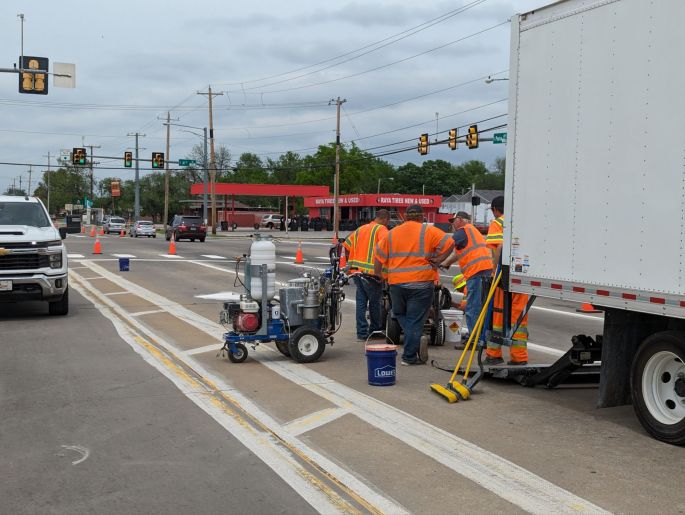

Pedestrian safety is a crucial issue that requires community engagement and participation.
In recent years, many communities have been seeking ways to increase awareness of pedestrian safety, especially in crosswalks, and provide financial support for accident victims. One effective change model that can be used in such communities is Appreciative Inquiry.
Appreciative inquiry is grounded in the principles of positive psychology, which suggests that organizations can achieve more success by embracing their strengths and capabilities rather than trying to fix their weaknesses. This approach encourages individuals and teams to explore what they are doing well, what they can improve on, and what new possibilities can be created through collaboration and innovation.
Appreciative Inquiry is a strengths-based approach to change that focuses on what is working well and what is possible, rather than on what is wrong or needs fixing.
From Data-to-Action, How the Tulsa Equality Indicators Report Can Drive Positive Change
In the City of Tulsa there’s a working group of public safety advocacy organizations advancing the ideas of transformative change, especially in the areas of Quality of Life and Measurable Equity.According to the Tulsa Equality Indicators Report, the city’s average scores for 2023 have improved in four of the six themes when compared to the baseline scores from 2018. Economic Opportunity, Education, Housing, and Public Health scores went up by approximately 5, over 12, 2, and nearly 8 points, respectively. However, Justice and Service scores decreased by approximately 5 and 1 points, respectively. These scores are definitely factual and offer a concise explanation of results oriented implementation efforts in the city.
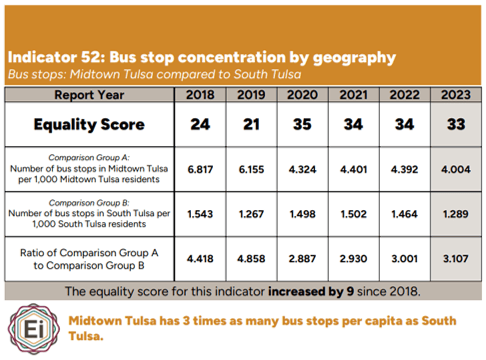
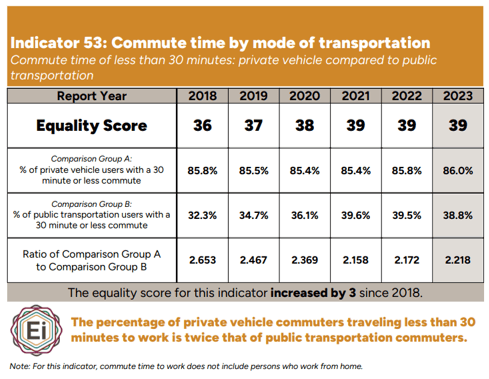
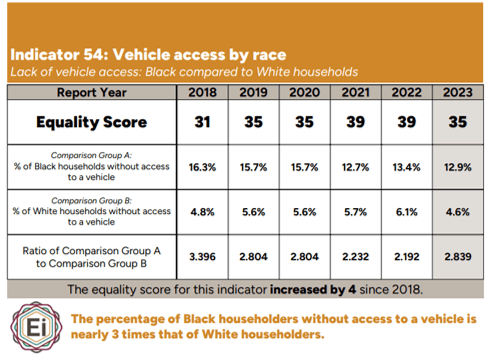
To measure and track the level of inequality in Tulsa, the report uses a methodology developed by the City University of New York, Institute for State and Local Governance (CUNY ISLG), which employs 54 indicators equally distributed across six themes. Each indicator is scored on a scale from 1 (high inequality) to 100 (high equality). Specifically, under the Services Theme three equality indicators are germain to public transportation safety. Indicators ( [52] Bus Stop Concentration by geography 33 previous year 34.), ( [53] Commute time by mode of transportation 39 previous year 39.), & ( [54] Vehicle access by race 35 previous year 39.)
Interpreting the data:
- Fewer African-American Black People are afforded an opportunity to have a motor vehicle that the previous year. “The percentage of Black householders without access to a vehicle is nearly 3 times that of White householders.“
- Fewer Bus Stops available for African-American Black People residents that the previous year. “Midtown Tulsa has 3 times as many bus stops per capita as South Tulsa.“
- The Commute time for all races of people remained the same. “The percentage of private vehicle commuters traveling less than 30 minutes to work is twice that of public transportation commuters.“
This year, the highest scoring indicators were “Housing Complaints by Geography” and “Veterans Affairs Appointment Wait Time,” each with a score of 100. On the other hand, “Payday Loans and Banks by Geography” had the lowest score of 1. “South Tulsa has 2½ times the number of Neighborhood and homeowner Associations as East Tulsa per capita.”
The indicator that showed a significant positive change score since 2018 is “Chronic Absenteeism by Race,” with an increase of 58 points. However, the indicator with the most significant negative change score since 2018 is “Homelessness by Veteran Status,” with a decrease of 30 points.
By identifying the positive aspects of a community’s current situation, Appreciative Inquiry can help build momentum for change and inspire action.
Tulsa Equality Indicators was initiated in 2017 by the City of Tulsa and the Community Service Council as a tool to measure and track disparities among subgroups of Tulsans over time.
An equality indicators report can be useful in appreciative inquiry. Such a report can help identify areas of inequality and provide data to support a more equitable approach. This information can be used to guide the inquiry process and ensure that all voices are heard and valued. By using data to understand the current state of affairs, appreciative inquiry can be more effective in promoting positive change and creating a more inclusive and equitable environment. ( To find out more about https://www.cityoftulsa.org/equality-indicators/)
To use Appreciative Inquiry in a community seeking pedestrian awareness and support for accident victims, the following steps can be taken:
1. Define the topic
The community should agree on the specific focus of the inquiry, such as crosswalk safety or accident victim support.
2. Discover
The community should identify the positive aspects of the current situation, such as successful pedestrian safety initiatives or existing support networks for accident victims.
3. Dream
The community should envision what could be possible and identify goals for the future, such as increased crosswalk education or improved financial support for accident victims.
A community action plan is a document that helps communities prioritize needs, set activities, and communicate needs to local and state governments.
Action plans can help communities work together to improve conditions that matter to residents. They can also help communities:
Understand community perceptions of issues and potential solutions
- Ensure inclusive participation in the planning process
- Build consensus on what should be done based on community needs and assets
- Specify actions that community members can take
4. Design
The community should develop action plans to achieve the goals identified in the Dream stage.
Action plans are strategic tools that outline steps, tasks, and goals to achieve an objective. They provide a roadmap for individuals, teams, or organizations to follow to accomplish their goals.
Here are some things to consider when completing a community action plan:
Partnerships, Budget, Alignment with the community’s mission and vision, and Feasibility.
A community action plan should include:
A statement of goals or output, Activities to reach the goal, A target date for completion, A schedule for each activity, and Identification of who is responsible for each activity.
5. Deliver
The community should implement the action plans and monitor progress towards the desired outcomes.
Throughout this process, it is important to involve all stakeholders in the community, including pedestrians, drivers, local businesses, and government officials.
By working together, the community can create a safer and more supportive environment for pedestrians and accident victims.
Appreciative Inquiry is a powerful model for change that can be used to increase pedestrian awareness and support for accident victims in communities. By focusing on the positive aspects of the community and building on its strengths, Appreciative Inquiry can inspire action and create lasting change. Below we have created three fictional scenarios where this appreciative inquiry change model could be useful in deciding the participants that are willing to become advocates for public safety campaigns.
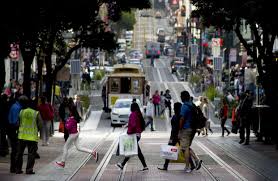
A small town with a high number of pedestrian accidents
The town has seen a rise in the number of accidents involving pedestrians, and the local authorities are concerned about the safety of the residents. The community decides to use Appreciative Inquiry to address the issue. The inquiry process focuses on the strengths of the community in terms of pedestrian safety, such as the active participation of local groups in promoting safe walking and the presence of well-maintained sidewalks. By building on these strengths, the community can develop a more robust pedestrian safety plan that addresses the root causes of the accidents.
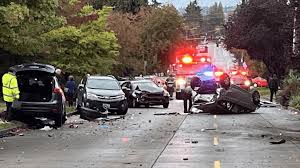
A neighborhood with a history of hit-and-run accidents
A woman was shot in the back during a possible road rage incident in Tulsa on Saturday. This neighborhood in the city has been plagued by gun violence crimes and hit-and-run accidents, and the local authorities are struggling to address the issue.
Often residents in the community use Appreciative Inquiry to create a more effective response.
The inquiry process focuses on the positive aspects of the community, such as the presence of active community watch groups and the willingness of residents to help each other in times of need.
By building on these strengths, the Pine and Peoria community can develop a more comprehensive plan that involves the active participation of all members in preventing and responding to gun violence crimes and hit-and-run accidents.
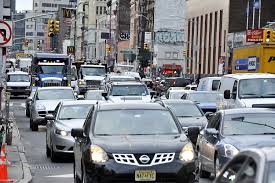
A city with high traffic and pedestrian congestion
A busy city with high levels of traffic and pedestrian congestion is struggling to create a safe environment for pedestrians. The community decides to use Appreciative Inquiry to identify the strengths of the community and develop a more effective response. The inquiry process focuses on the positive aspects of the community, such as the presence of bike and pedestrian paths and the active participation of local groups in promoting safe walking. By building on these strengths, the community can develop a more comprehensive plan that involves the active participation of all members in creating a safer and more pedestrian-friendly environment.


