

What is negative reinforcement?
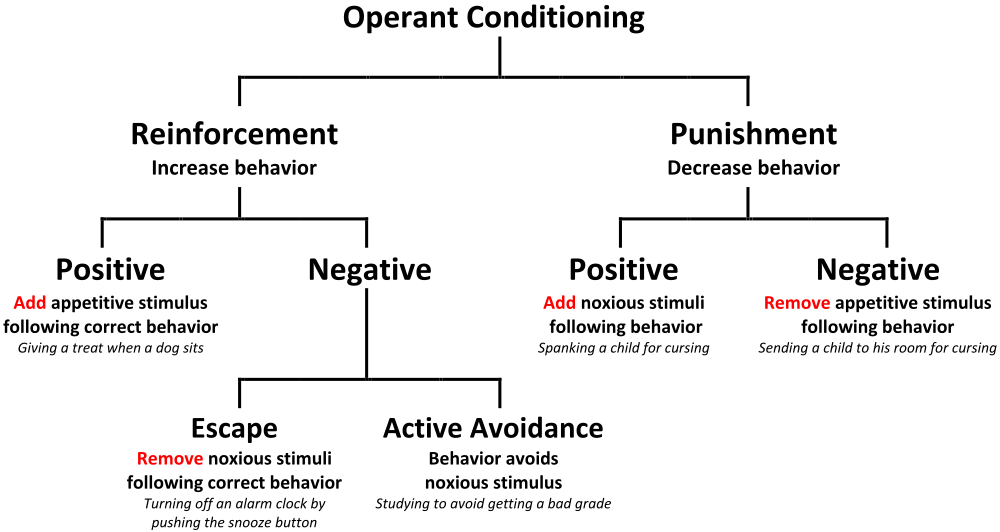
Negative reinforcement is the encouragement of certain behaviors by removing or avoiding a negative outcome or stimuli. People typically use this technique to help children learn good patterns of behavior, but it can also play a role in training animals and pets.
How Negative Reinforcement Works in Psychology?
Skinner argued that people’s behavior is mostly determined by external influences, not just by their nature. He saw the direct relationship between behavior and consequences that occur after people do something. Reinforcement is one of those factors that exert behavioral transformation when used adequately.
Examples of Negative Reinforcement
- Giving a pass to the car behind to avoid its honking.
- Getting up from bed to avoid the noisy alarm.
- Taking an antacid before having a spicy meal.
- Applying sunscreen before heading to the beach to avoid getting sunburned.
- Leaving early from the house early to avoid traffic jams.
What is negative reinforcement in a relationship?
Couples often use negative reinforcement without even being aware of it. It is the situation when something negative is removed, and the relationship becomes stronger.
For example, if a couple is having an argument, and one of the partners refuses to talk to the other partner, it creates an odd situation where none of them feels happy.
The decision to discuss the issue and have proper communication is an example of negative reinforcement.
How do teachers use negative reinforcement?
Teachers use negative reinforcement to signal students that they believe in students’ sound reasoning and ability to adhere to rules and obligations.
For instance, when a teacher removes a task or extra homework because of a student’s improved behavior and his class involvement, that student is likely to continue his/her good behavior.
What are examples of negative reinforcement in sports?
The sports arena is a place where players need constant improvement and motivation to succeed, so no doubt that both forms of reinforcement are frequently used.
Negative reinforcement in sports includes removing something undesirable that follows a good behavior.
For instance, after a winning match, the team is allowed to skip the training for the day and enjoy their free time outdoors.
Or, if a player was given a time-out, returning to the game is also an example of negative reinforcement.
Negative reinforcement techniques
Negative reinforcement is the idea of taking away an unwanted stimulus in order to encourage good behavior. A good example in the classroom would be a teacher taking away homework because the class was so well behaved. The students avoid the unwanted stimulus (homework) by exhibiting a wanted behavior.
Characteristics of negative reinforcement
Take, for instance, angry parents that argue with their teenage daughter about the mess in her room. Arguing is the aversive stimulus that influences the daughter to clean up the mess.
Once she has done it, her parents’ anger is gone, and they get on well. Seeing the positive home environment and her parents’ satisfaction is likely to influence the girl to clean her room every time her room gets untidy.
Rather than delivering an aversive stimulus (punishment) or a reward (positive reinforcement), negative reinforcement works by taking away something that the individual finds undesirable. This removal reinforces the behavior that proceeds it, making it more likely that the response will occur again in the future.
Reinforcement Schedule Types
Behavioral psychologists recognize two basic forms of reinforcement schedules:
- Continuous Reinforcement
- Partial Reinforcement
Continuous Reinforcement
Continuous reinforcement means strengthening the desired behavior every time it occurs.
It is the most recommended technique to stimulate new processes or new activities because the link between the response and the behavior is the most evident.
In other words, when teaching new activity, the desired response gets followed by a defined consequence that stimulates the behavior.
Partial (Intermittent) Reinforcement
This reinforcement type follows continuous reinforcement after establishing a firm response.
As the name implies, it doesn’t happen every time the desired behavior happens, but periodically, to enhance already learned behavior.
Thus, it is a more natural form of reinforcement and sufficient to strengthen the behavior.
Partial reinforcement has four schedules:
- Fixed-Ratio Schedules – Here, the reinforcement occurs after a specific number of responses that you have previously set. For instance, if you teach a child to write, you will stimulate him/her only after they have written five sentences.
- Variable-Ratio Schedules – The reinforcement here occurs after a random number of responses, but the rate usually is steady. It is a method used in casinos and gambling sites to stimulate the participants.
- Fixed-Interval Schedules – Here, the reinforcement happens after a certain point of time has passed.
- Variable-Interval Schedules – With these schedules, the behavior is reinforced after an undetermined time has passed. The rate of response here is slow and steady.
Negative Reinforcement Vs Negative Punishment
Reinforcement and punishment are the two key concepts in Skinner’s operant conditioning. While both influence behavior change, their end goals greatly differ.
Reinforcement aims to encourage or stimulate certain behavior, while punishment discourages or prevents a certain behavior from happening.
The only thing they have in common is the way they are carried out. Namely, negative in both methods means that something is removed or taken away to influence behavior change.
Negative Reinforcement Vs Positive Reinforcement
One of the most common misconceptions about negative and positive reinforcement is thinking of them as good or bad.
However, they are both methods used to foster behavior. And, as we have said, positive reinforcement means that a stimulus is added to strengthen a behavior, unlike negative reinforcement, where usually adverse stimuli are removed.
You can think of positive reinforcement as methods that stimulate or engage a person in a specific, desired behavior.
The most common forms of positive reinforcement include verbal praise, promotion, appreciation, or reward.
It is a very effective method, and it is widely used in all social environments.
Pros and Cons of Negative Reinforcement
Advantages of Negative Reinforcement
- Negative reinforcement usually delivers immediate results, and it takes a lower effort to impose the desired behavior.
- With negative reinforcement, you don’t need constant follow-up, as removing the adverse stimuli is effective enough to maintain the behavior.
- It can increase a person’s self-confidence and boost his/her potentials.
Disadvantages of Negative Reinforcement
- Since the removal of negative stimuli is self-explanatory, negative reinforcement can discourage communication, leading to misunderstanding.
- It imposes compliant behavior without much choice left.
- Non-compliance can have an opposite effect, and when used in animal training, it can be even dangerous.


2 thoughts on “Tactical Negative Reinforcement to Change Workplace Behaviors”