
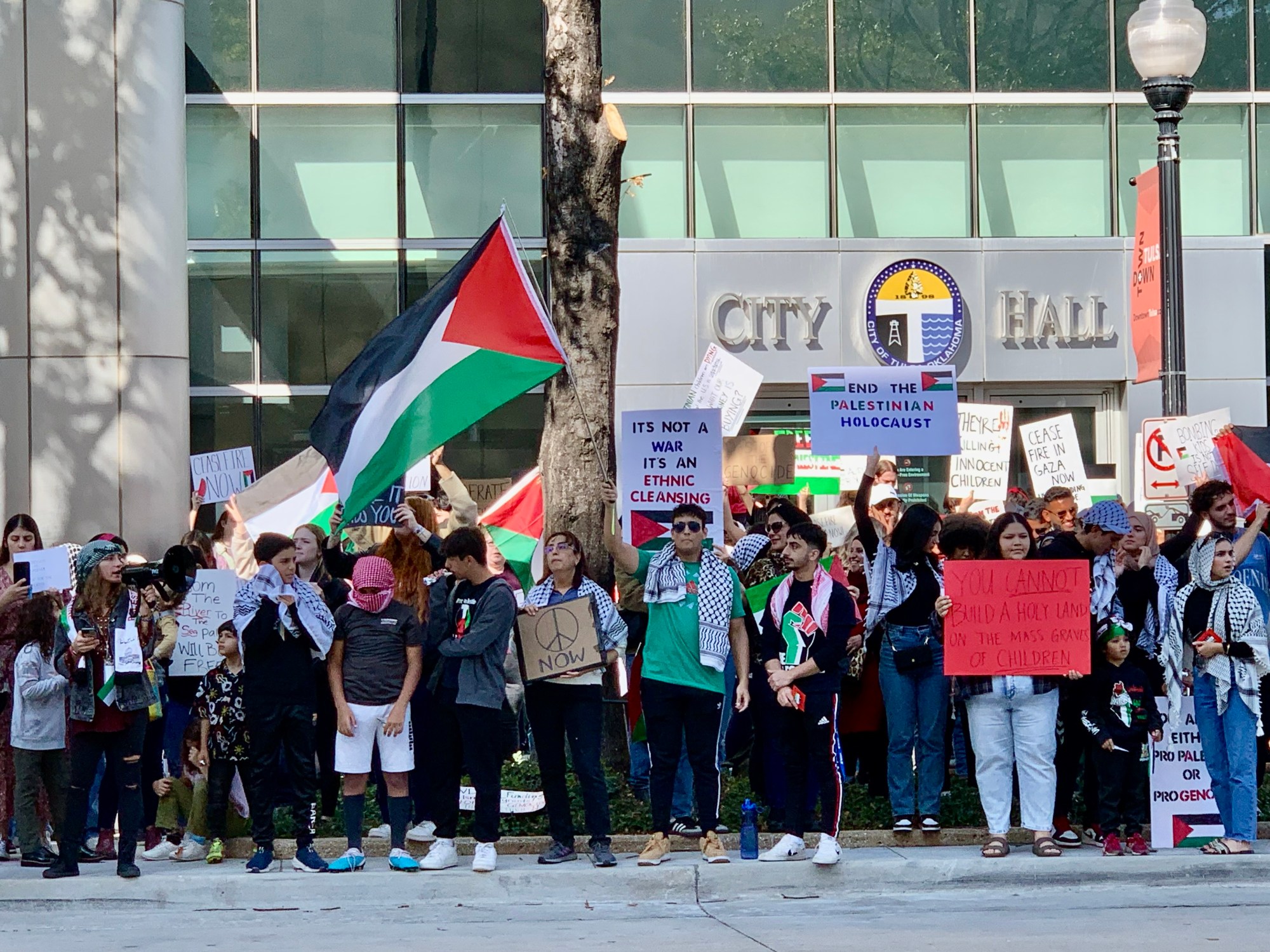
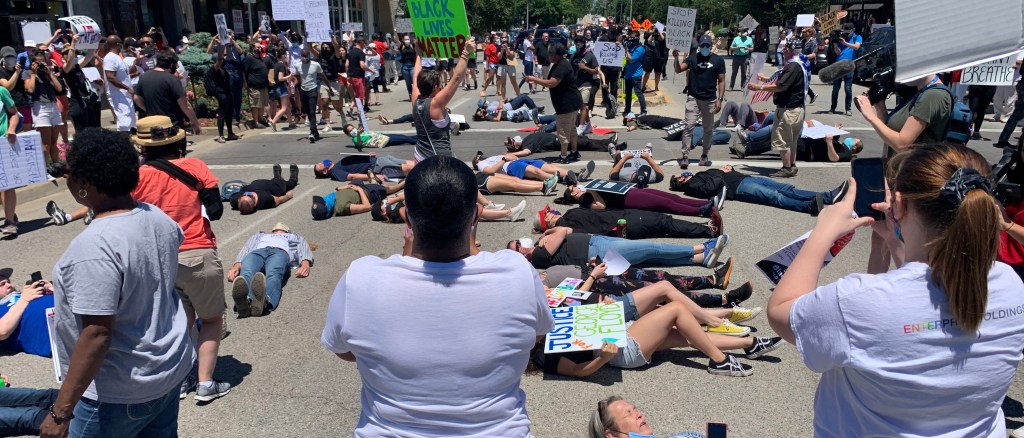
We’re here to address the root cause of the violence
Demonstrators protest outside Tulsa City Hall on Saturday, Nov. 4, 2023, after Israeli air strikes and a ground invasion of Gaza in its war with Hamas.
Following a month of war between Israel and Hamas, protesters in Tulsa joined demonstrators across the world calling for an end to violence in Gaza.
Scores of demonstrators brought signs and Palestinian flags to the front entrance of Tulsa City Hall on Saturday afternoon. They stayed there for hours, yelling chants and giving speeches.
The event was organized by the grassroots organization Oklahomans Against Occupation.
Palestinians have been at odds with the Israeli government since after World War II, when Israel was reestablished as a country on land the Palestinians lived on at the time. After the militant group Hamas assumed power over the Palestinian Gaza Strip in 2006, Israel quarantined the land to the point where a United Nations human rights expert called Gaza an “open-air prison” this summer.
When asked about the Hamas attacks, Oklahomans Against Occupation organizer Khalil Shaheed pointed out that the Palestinian struggle predates Hamas by decades.
“We’re here to address the root cause of the violence,” Shaheed said.
Shaheed said his organization calls for the end to the violence, a ceasefire and an end to Israel’s siege of Gaza.
RESOLVING DISPUTES BY MEDIATION

What Mediation Is
Mediation is a form of dispute resolution that allows individuals and/or organizations involved in a dispute to work together towards resolving their own differences.
During mediation, trained mediators work closely with the disputing parties by listening to all sides of the dispute, identifying areas of concern, and exploring underlying interests and possible solutions.
The mediation process gives parties the opportunity to tell their story and to hear the other person while focusing on moving forward.
Mediators remain neutral throughout the process and unlike a magistrate or judge, mediators do not decide the outcome; the outcome is determined by the parties themselves.

Benefits Of Mediation
- Voluntary – Mediation is a voluntary process for everyone involved.
- Confidential – Mediation sessions are confidential except in rare circumstances. Mediators cannot be called to testify about what was said in mediation.
- Non-judgmental – Mediators are not judges, they do not take sides or tell parties what to do.
- Positive and forward looking – Through mediation, parties usually develop a better understanding of each other even if they don’t reach a mediated agreement, by improving communication, hearing the other person’s point of view and thinking abut their future relationship.
- Empowering – Parties craft and control the outcome of each mediation.
- Successful – Parties are more likely to follow the requirements of a mediated agreement because they have crafted it themselves.
- Timely – Mediations can often happen more quickly than waiting for a court date.
- Convenient – Mediations can be arranged at a convenient time and place (with options for phone or video conference arrangements).
HMP’S MEDIATION MODEL
WHO WE ARE, WHAT WE DO
HMP employs a facilitative, co-mediation model that is premised on three main principles:
- The self-determination of the parties;
- The informed consent of the parties; and
- The neutrality of the mediators.
The Harvard Negotiation & Mediation Clinical Program (HNMCP) is an academic program at Harvard Law School focusing on cutting edge work in dispute systems design, negotiation, mediation, facilitation, and conflict engagement.
Clients in our Dispute Systems Design Clinic include U.S.-based and international private corporations, non-profit organizations, government agencies, and community groups.
Check your community web directory to find mediation organizations like HMP in your area.

HMP’S FACILITATIVE MEDIATORS
As facilitative mediators, HMP mediators strive to help the parties create a process that best suits their dispute and enables them to reach a mutually agreeable solution.
To that end, HMP mediators do not endeavor to solve the parties’ problem or impose solutions – rather, mediation with HMP creates a safe and neutral environment in which parties can discuss their dispute and seek to move towards resolution.

HMP’S CO-MEDIATORS
As co-mediators, HMP mediators draw on the skills of two trained mediators to conduct each mediation in accordance with the three main principles above.
Here’s an illustrative list of the types of topics participants might engage:
- How do we design systems (in the context of the criminal system, the housing system, the healthcare system, etc.) that account for the interlocking systems of oppression in which so many people find themselves?
- How do we better ensure that we are designing systems with the guidance, wisdom, and consent of the communities they serve?
- How do we do a better job attracting, supporting, empowering, and promoting teachers, mediators, arbitrators, and practitioners of color?
- How do we better serve parties of color in our mediation (or arbitration, or restorative justice, or community dialogue programs)?
- How do we foster greater self-determination in parties working within the court system?



One thought on “Resolving Disputes by Mediation”