
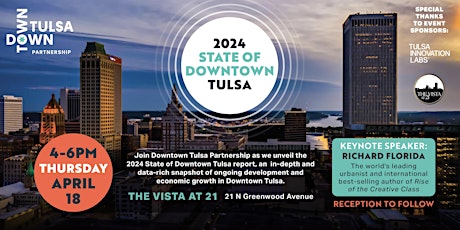
According to Emily Scott, Downtown Tulsa Partnership's Director of Planning and Vitality, this year's report on downtown Tulsa will depict the potential future of the city. The report will showcase the conversion of office spaces or commercial properties into residential or housing units, which has been a growing trend downtown. This trend has been accelerated by the pandemic and the shift towards remote or hybrid work, resulting in a reduction of in-office workers.
Scheduled for Thursday, April 18, 2024 The Downtown Tulsa Partnership’s review will measure the overall economic health and strength of Tulsa’s downtown area.

by pacetulsa

A non-profit organization committed to revitalizing downtown Tulsa, Oklahoma.
Downtown Tulsa Partnership
The organization is focused on creating a vibrant, walkable, and livable downtown area that attracts residents, businesses, and visitors. To achieve this goal, the organization has embarked on a strategy to convert underutilized office spaces or commercial properties into residential or housing units. With the pandemic-induced shift towards remote or hybrid work, the demand for housing in downtown Tulsa has increased.
“The Downtown Tulsa Partnership has agreed with the City of Tulsa to manage the Tulsa Stadium Improvement District services by providing enhanced maintenance, beautification, and livability services; mobility and public realm planning; and marketing and place enhancement initiatives that result in a thriving, vibrant, and inclusive urban neighborhood.”
Key Highlights:
Capital Improvement Framework
- At the core the plan is a Capital Improvement Framework. This component outlines a series of targeted investments and public realm enhancements set to unfold over the next decade. Our approach is meticulously aligned with both current and projected public and private investment opportunities, ensuring a cohesive and forward-thinking development strategy.
Priority Investment Area Analysis
- A cornerstone of our strategy is the in-depth analysis of Priority Investment Areas within Downtown. Our team, leveraging extensive research and understanding of market dynamics, will identify key geographies of Downtown for targeted investment. This analysis not only considers the current state of these areas but also their potential, factoring in existing assets and emerging opportunities.
From their website Downtown Tulsa Partnership says, “The development of the Downtown Strategic Investment Plan is guided by a local Steering Committee of 30+ Downtown Tulsa stakeholders and the planning process will evolve throughout its creation from the valuable input from our community.”
To navigate change and urban transformation, the Downtown Tulsa Partnership can leverage the Burke-Litwin Change Model framework. This framework consists of 12 interconnected elements that can influence organizational change. These elements can be divided into two categories: transformational factors and transactional factors. The transformational factors are the more significant drivers of change, while the transactional factors are the more immediate and visible aspects of change.
The Burke-Litwin Change Model framework can be applied to the conversion of office spaces or commercial properties into residential or housing units by the Downtown Tulsa Partnership.
The mission and strategy of the organization must align with this goal. The leadership of the organization must have a clear vision and commitment to creating a vibrant downtown area. The organizational culture must be focused on collaboration, innovation, and community engagement. The organizational structure must be designed to facilitate collaboration and innovation. The systems and processes must be adapted to support the conversion of office spaces into housing units.
The transactional factors must be considered.
*The work climate must be positive and supportive.
The task requirements and expectations for this project are significant and complex.
*Clear communication and expectations will be essential for the successful implementation of this project.
*The individual skills and abilities of staff and stakeholders will be critical for the successful implementation of this project.
Training and development will be necessary to ensure that everyone involved has the necessary skills and knowledge.
*The individual needs and values of staff and stakeholders must be considered when implementing this project.
Motivation will be essential for the successful implementation of this project.
*Staff and stakeholders must be motivated and engaged to support the conversion of office spaces into housing units.
Individual and group performance will be critical for the successful implementation of this project.
*The output of this project will be the conversion of office spaces into housing units. These outputs will have a significant impact on the vibrancy and economic potential of downtown Tulsa.
By considering all of these factors, Downtown Tulsa Partnership can successfully implement this ambitious project and achieve its mission of creating a vibrant, walkable, and livable downtown area.
The Burke-Litwin Change Model provides a useful framework for understanding the complex factors that influence organizational change.
Downtown Tulsa Districts
Arena District
Launched in February of 2018, the Arena District Master Plan is guiding the City and its partners in developing improvements to the District’s public realm. This master planning process will assess the current state of the District, evaluate the potential of public infrastructure investments, identify opportunities for private development, and provide a phased roadmap for future decisions.
Blue Dome District
The Blue Dome District is one of Tulsa’s most popular entertainment districts. Anchored by the 1924 Blue Dome building, this district offers incredible nightlife and a broad selection of local restaurants, shops, and bars.
Cathedral District
Located at the southern end of Downtown Tulsa, the Cathedral District boasts a rich combination of faith, life, business, and culture. Tulsans across the city are drawn Downtown every day by the six historic churches, Tulsa Community College, and up-and-coming entertainment and dining hot spots.
Deco District
Tulsa’s Deco District is located in the heart of Downtown Tulsa and boasts the City’s most robust collection of Art Deco buildings. Featuring offices, apartments, restaurants, shops, and entertainment venues, this district celebrates and blends its history with new modern touches.
East Village
Affectionately referred to as “the sunny side of downtown” for its geographical location and sunny disposition, Downtown Tulsa’s East Village District hosts a variety of restaurants, nightlife, performing arts, and business and retail services.
Historic Greenwood District
The Historic Greenwood District, which stretches from Martin Luther King Blvd. to east of Greenwood Ave., is experiencing a renaissance of new business. This district was popularly known as America’s “Black Wall Street” until the devastating Tulsa Race Massacre of 1921 destroyed the once-thriving Greenwood community. Visit John Hope Franklin Reconciliation Park and the Greenwood Cultural Center to honor the victims of the Tulsa Race Massacre, or stop in one of the many black-owned galleries, restaurants or businesses located here.
Gunboat Park
Located in the southeast corner of Downtown Tulsa, Gunboat Park gets its name from its unique gun boat shape with parks located at each “tipped” end. The district is home to residents and more than 20 businesses. With easy access to both Downtown Tulsa and Historic Route 66, this neighborhood perfectly connects Downtown to neighboring areas of Tulsa.
Tulsa Arts District
The Tulsa Arts District is a diverse, culturally-robust district in Downtown Tulsa. Grown from a historic oil-rich past with icons including The Tulsa Theater and Cain’s Ballroom, the district has evolved over time to become a creative, community-driven engine of the Tulsa economy.
To read more about Downtown Tulsa Partnership’s
Contact DownTown Tulsa Partnership
Mailing Address:
Downtown Tulsa Partnership
321 S. Boston Avenue, Suite 104
Tulsa, OK 74103
General Inquiries:
Phone: 918.221.8615
Email: Hello@DowntownTulsa.com
Ambassador Service Requests:
Phone: 918.202.4093
Email: Service@DowntownTulsa.com
Media Contact:
Morgan Phillips, Director of Marketing & Experience: 918.671.2708


