

Change is a constant in our evolving business world. It's crucial for organizations to adapt and evolve in order to stay competitive. But how does one effectively manage change within an organization? Many models and approaches have been developed to address this challenge, and one such model is Galpin's Change Wheel.

PACETULSA.COM

by pacetulsa
Timothy Galpin Managing Change
In his 1996 book Timothy Galpin identified nine steps in managing change. He arranged these as nine segments. Underpinning each segment of the model is the need to understand the culture of the organisation. Galpin identifies this culture as being reflected in its rules, policies, customs, norms, ceremonies, events, rewards and recognition. He maintains that for change to be successful, it must be addressed at two levels: strategic and grassroots. The strategic level includes executives and senior managers, while grassroots refers to the activities that drive change deep into the organisation and ensure the change is embedded at a local level. Tim’s areas of expertise include mergers and acquisitions, strategy formulation and execution, organisational transformation, and culture change.
The Strategist’s Handbook
Timothy Galpin. A practitioner “handbook” that also makes the connection between practice and academic theory and research. Supported by well-established theory and extensive research.
Presents practical application, tools and templates. Analyzes the best practices and potential pitfalls across the strategy process. Includes strategy formulation and strategy execution.
Tim brings over three-decades of practical knowledge and experience, combined with proven approaches and pragmatic tools to his teaching and consulting with organisations in various industries around the world. He helps them successfully plan, implement and accelerate the complex cross-disciplinary efforts of strategy formulation and execution, mergers and acquisitions, organisational transformation, and culture change.
Tim has authored six management books, two of which have achieved best seller status and have been published in six languages. Had Galpin addressed P3 management specifically, he would no doubt have linked ‘successful change’ with the realisation of benefits defined in a business case.
Winning at the Acquisition Game

Timothy Galpin. Provides a comprehensive overview of the entire M&A process through an actionable ten stage Deal Flow Model, which can be used as an organizing framework to record, catalog, and categorize distinct M&A practices. Includes practical tools and templates that readers can apply to their own transactions as well as case examples of M&A practices from various industries. Presents key findings from the the Oxford M&A Insights Project, with input from 337 executives and managers across 31 industries spanning over 40 countries
Accessibly written as a useful guide for both experienced practitioners and scholars of M&A
Galpins Change Wheel
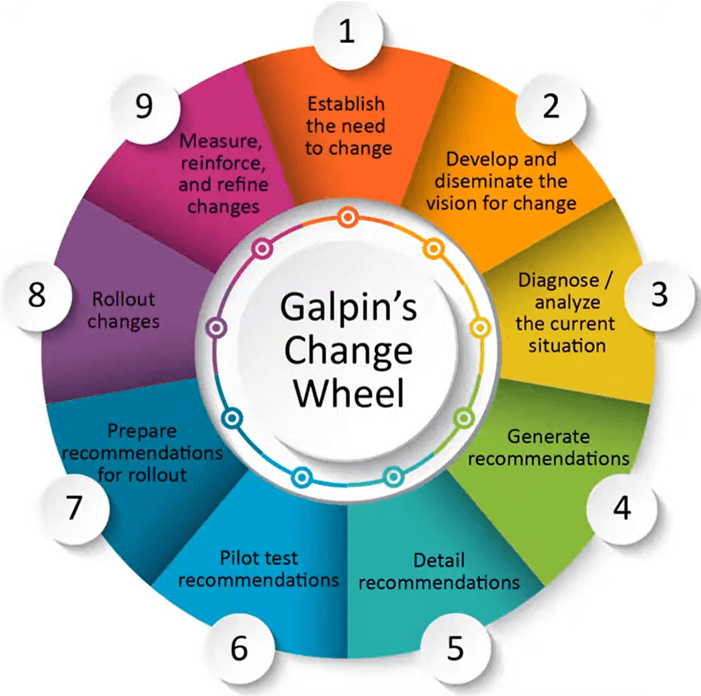
Galpin’s Change Wheel is a nine-step process that blends iterative approaches with traditional refinement. Unlike other models that require cycling through the steps for each iteration of the change, Galpin’s model advocates staying in step nine until the change is deemed complete. But is this approach effective in today’s dynamic business environment?
Let’s take a closer look at the steps of Galpin’s Change Wheel
1. Establish the need for change: Similar to Kotter’s first step, creating urgency is essential to provide the energy to drive the change process forward.
2. Develop and disseminate the vision of the change: Creating buy-in and ensuring that individuals understand the vision is crucial for successful implementation.
3. Diagnose and analyze the current situation: Understanding the current state is fundamental in developing a plan to transition to the desired future state.
4. Generate recommendations: Identifying potential paths from the current state to the future state is a key aspect of the change process.
5. Detail recommendations: Providing detailed options for testing is crucial for refining the change strategy.
6. Pilot test recommendations: Implementing small-scale changes allows for learning and refinement of recommendations.
7. Prepare recommendations for rollout: Scaling up and preparing for broader implementation based on pilot test learnings is essential.
8. Roll out changes: Implementing and scaling the recommendations more broadly is a critical step in the change process.
9. Measure, reinforce, and refine changes: Monitoring, adapting, and reinforcing changes until old behaviors are extinguished is necessary for sustained change.
Limitations and Criticisms
While Galpin’s Change Wheel offers a structured approach to change management, it has its limitations and criticisms. One of the key drawbacks is its lack of support for repeated iterations of the whole model, limiting its applicability to continuous change seen in organizations today. Additionally, the model’s reliance on detailing recommendations assumes that the scale of change can be achieved in one iteration, which may not be feasible for complex, ongoing organizational challenges.
Galpin’s Change Wheel provides a valuable framework for addressing large-scale changes, its limitations in accommodating iterative and adaptive change processes make it less suitable for today’s dynamic organizations. As businesses continue to evolve, it’s essential to consider models that embrace flexibility and iteration to effectively manage change in the long term.
Sources:
Timothy J. Galpin, 1996, The Human Side of Change: A Practical Guide to Organization Redesign, John Wiley & Sons


